
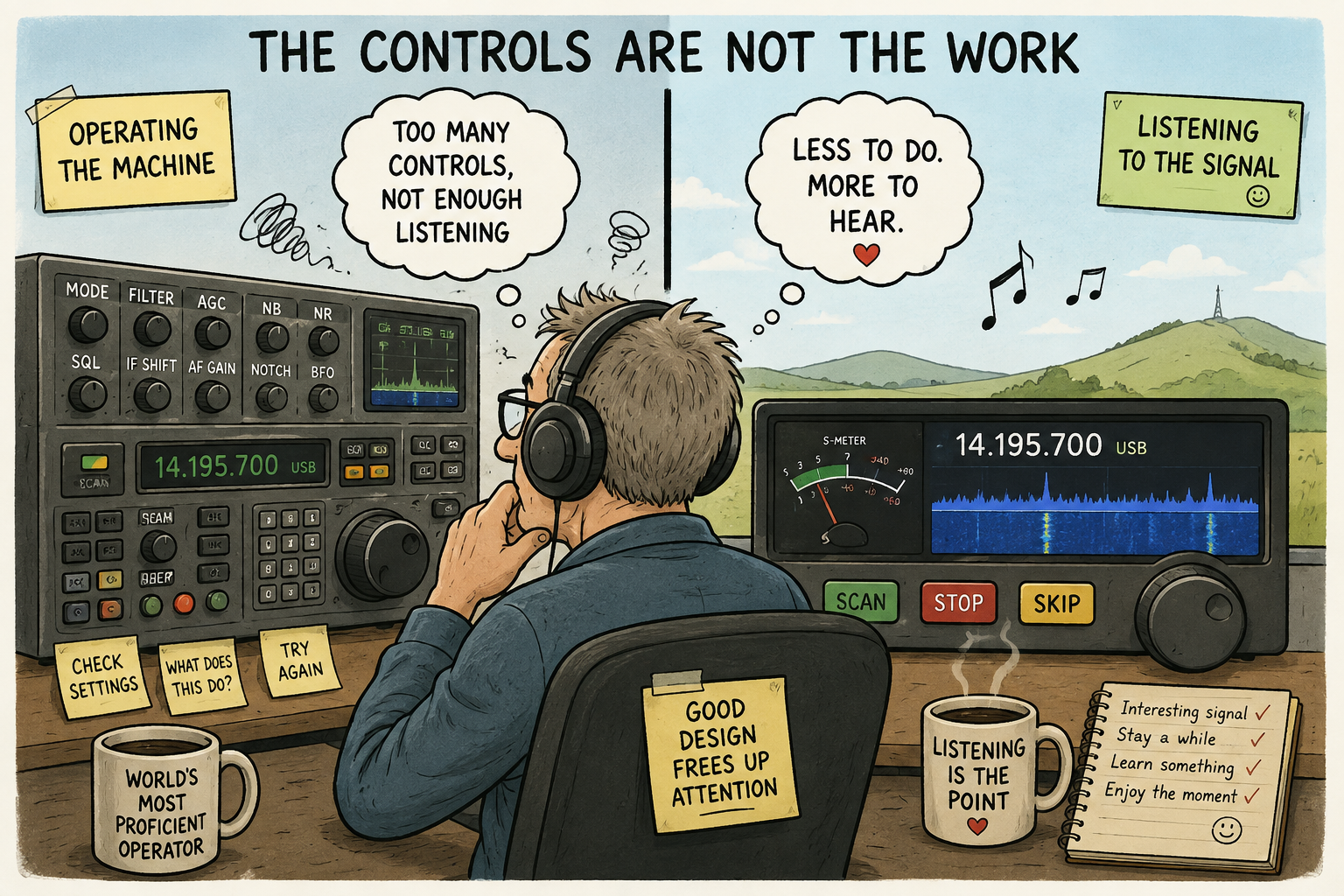
People who saw my earlier post will already know that radio has been an interest of mine for years. Through ORAC (my personal engineering laboratory), I have been rebuilding the interface I use with my Icom IC-R8600 communications receiver around the way I actually listen.
The radio is extraordinarily capable. It gives precise control over almost every part of the listening process, and its physical controls and factory software reflect that.
Very impressive. Also quite a lot to deal with when all I want to do is hear what is out there.
Start with the listening
When I am scanning, the activity is fairly simple. I choose an area of interest, start the scan, see where the receiver stops and listen to what it has found. Then I decide whether to stay, skip or carry on.
The interface we designed follows that sequence. The current signal is clear, the immediate controls are close at hand and very little setup is required.
Searching the HF bands for Morse and other communications is a different experience. There I want to explore part of the spectrum, notice a signal, tune it carefully and work out what is emerging through the noise. That needs a different view of the same receiver.
Trying to make one screen serve both activities would display a great deal of capability. It would also make both activities less enjoyable.
Every control takes some attention
The hardest part has been deciding what to leave out.
Adding another control is easy and satisfying, because you can see what you have built. The creative instinct encourages it. Once a function exists, giving it a place on the screen feels like the natural next step.
Taking something away requires more confidence. While every control can defend its place, every control also takes a little attention.
After using the new interfaces, the best measure of them became how little I thought about them.
When the scan stopped, my attention went to the transmission: the voice, the pauses, the signal fading towards the noise and whether I wanted to stay with it. I spent less time driving the machinery and more time listening.
The same focused interface can also operate the receiver across my network or travel with an off-grid setup to the top of a hill. Whether the radio is across the network or on top of a hill, I can get straight on with listening.
Why is this even remotely relevant? Well, think about an organisation…
The signals arrive before the dashboard
Meetings, reports, dashboards, targets, reviews and processes form a kind of management control surface. They are necessary, and competence with them matters. They can also absorb so much attention that nobody hears what the organisation is saying.
People rarely announce that a process is beginning to fail. They compensate for it.
They create a workaround, chase information manually, keep their own spreadsheet or stop trusting what the system tells them. A colleague hesitates before answering a familiar question. The same exception keeps appearing in slightly different forms.
Those are signals.
By the time they dominate the dashboard, the organisation may have been living with the problem for months. Late discovery is often expensive. Small problems have had time to spread, workarounds become embedded and the range of easy options starts to narrow.
Good management keeps the machinery working. Effective leadership also requires enough attention to notice what the machinery is not yet showing.
That is where listening matters. A leader who is not listening is in trouble immediately, because the earliest and most useful signals are often weak, awkward and inconvenient. They need judgement and investigation long before they are strong enough to appear in formal reporting.
Well-designed systems protect that attention. They keep capability available without placing all of it in the foreground at once. They help people concentrate on the part of the work that still needs a human being.
You can master the controls and still miss the signal.